Both clients have their own IT systems and their own policies, and in neither company may an external tool access the calendar. On top of this there is the interim manager's own calendar, in which everything is meant to come together, and that is exactly where the problem begins.
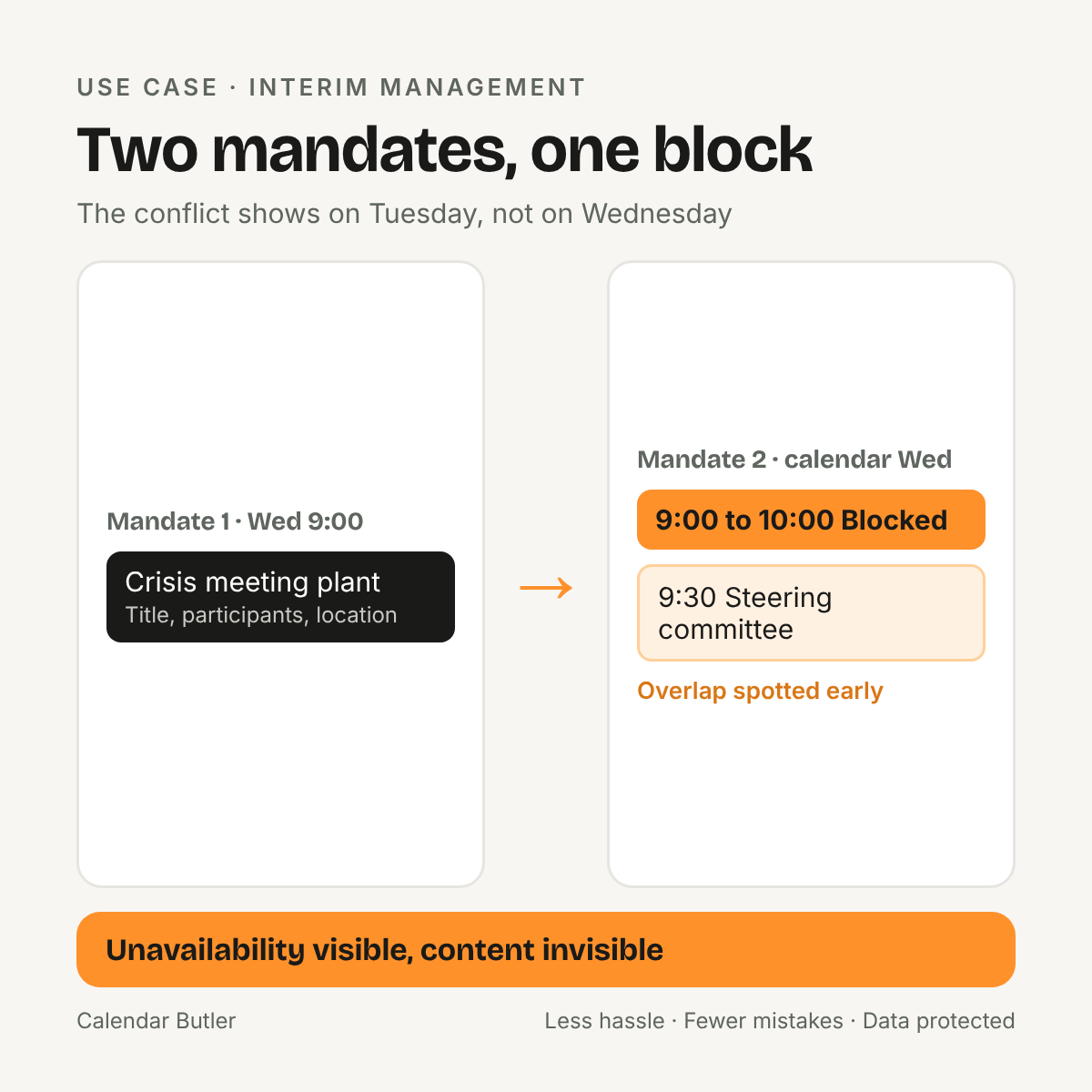
On Tuesday afternoon the management of the machine builder invites him at short notice to a crisis meeting on Wednesday at nine. Wednesday is one of the days at the supplier, and there a steering committee is in the calendar for half past nine, set up weeks ago by another participant. Without synchronization nobody notices the conflict until the interim manager is expected in both rooms on Wednesday morning.
Anyone who transfers by hand has two options, and both are unpleasant. If he enters the crisis meeting with its title in the supplier's calendar, it says “Crisis meeting plant” along with the participants, and the assistant who reads the calendar knows more than they should. If he enters nothing, he relies on his memory and risks the double booking.
Before talking about tools, it is worth looking at what actually has to be protected here, because the list is longer than just the appointment name.
The first three points require that nothing from one mandate becomes visible in the calendar of the other, the fourth requires that no time is nevertheless given away twice. A calendar that is meant to meet both needs start and end of the appointment, but nothing beyond that.
The Calendar Butler does not take a decision off the interim manager. Which mandate takes priority in case of conflict follows from the contracts and from the conversation with both clients, and that remains a question only he can answer. The Butler makes sure he can ask it in time, because the conflict is visible before it becomes expensive.
The second limit is simply that the Butler can only synchronize what it learns about. Invitations that never reach it create no block, which is why it is part of the routine to invite it to appointments or to forward invitations.
Interim mandates usually start at short notice, sometimes within a few days, and there is neither time nor reason to start an approval process for a tool at two clients. The Calendar Butler needs no access to either calendar, no ticket with either IT department and no installation, so that the synchronization can be in place on the first day of a mandate and end without leftovers on the last.
If you are in a similar situation, you can test the Calendar Butler free of charge for 30 days and check whether it fits your day.
The anonymous block is the right means for this, because it makes the unavailability visible to both clients without revealing where you are instead and for whom.
 Calendar Butler