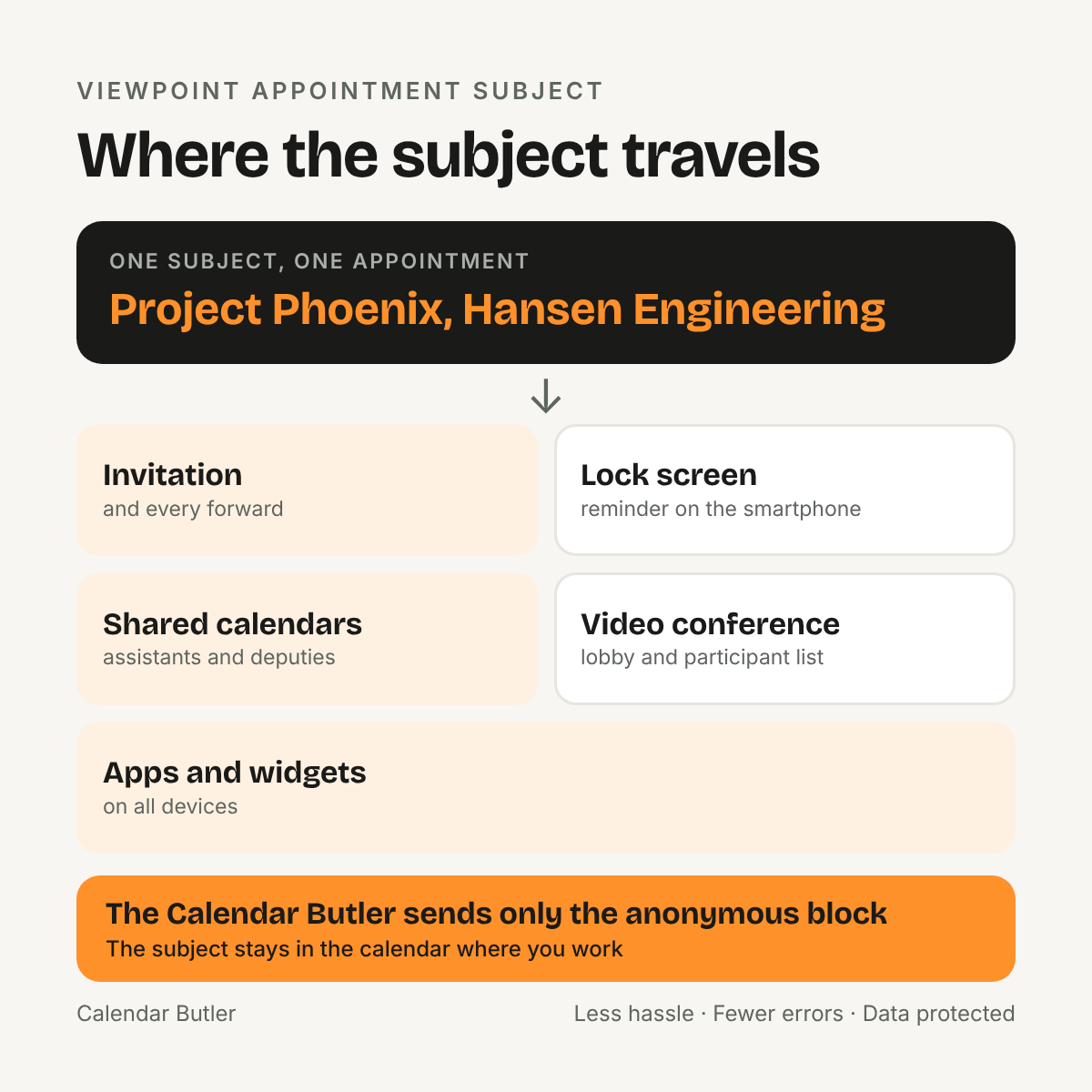
Our position on this is clear. The client name in the subject is client data and deserves the same care as the content of a document, because it travels with the appointment wherever the appointment goes, and it reveals, even when nothing else is in it, that this business relationship exists.
This viewpoint explains why the subject gives away more than many assume, examines the common objections and describes how you can keep your appointments so that you retain the overview and still carry nothing to the outside.
The subject is one of the fields that a calendar delivers almost everywhere, because it is the shortest description of an appointment.
Each of these places is harmless on its own and still follows different rules from your own calendar. A subject cannot be taken back once it has arrived there.
A client name seems inconspicuous because it is only a name, but in consulting, in the legal professions and everywhere that discretion is part of the business model, the relationship itself is information. Whoever learns that you are sitting at a certain company at ten o’clock on a Tuesday can draw conclusions as to whether a restructuring, a negotiation or a crisis is under way there, and whoever sees your appointments over weeks recognizes patterns that no single entry shows.
Legally, too, the name is no side issue. If it concerns a natural person, for example a client or a patient, the name is personal data within the meaning of the General Data Protection Regulation, and in the case of companies many contracts contain clauses that make even the fact of the cooperation confidential. Whether this applies to you is written in your contracts and not in this article, but the check is worthwhile before you type the next subject.
We do not argue for banning client names from your own calendar. That is where you work, that is where you need the overview, and a subject that tells you nothing is a poor tool. The mistake lies elsewhere, namely in the fact that the same entry serves at once as working note and as disclosure.
The clean solution separates the two. The appointment with all its details stays in the calendar in which it was created, and everything that leaves this calendar contains only what the recipient needs, namely start, end and the information that the time is taken. The Calendar Butler implements exactly this, because it reads the invitation once and sends an anonymous block to your other calendars, so that the subject with the client name stays where it belongs.
Whoever has only a single client and a single calendar can see all this calmly. As soon as several clients, several calendars or several people reading along are involved, the habit becomes a habit with side effects.
A simple test to finish: go through your calendar for the coming week and ask for every subject whether you would show it to the competitor of the client named in it. For every entry where the answer is no, the name in the subject has no business outside your own calendar.
 Calendar Butler