The best time management method is a calendar you don’t have to maintain
October 20, 2026 · by Calendar Butler · 8 min read
Every time management method assumes a calendar that is correct, and keeping it correct often costs more time across several client calendars than the method could ever save.
In a guide for founders I read about nine time management methods, from the Eisenhower matrix and the ABC method to the Pomodoro technique, and right at the first one there is a sentence that carries everything else: nobody who wants to take their time management to a new level gets around a calendar. That is true, and it is also the point where most methods quietly make a promise they cannot keep themselves.
Create a photorealistic image in 3:2 format: An open paper calendar on a desk, its weekly page full of pencil-written, crossed-out and overwritten appointments, next to a tablet showing a second, differently filled calendar, soft daylight from the side, main subject in the center, no stock photo look, no text in the image.
Every one of these methods starts from a precondition that is rarely spoken aloud. Anyone who sorts tasks by urgency, plans buffers or cuts the day into focus phases needs to know how much time is actually free, and that knowledge lives in the calendar or it lives nowhere. If the calendar is incomplete, you are building the method on sand, and the most beautiful matrix does not change the fact that on Wednesday at ten o’clock two appointments collide, one of which you overlooked.
This article therefore asks the question that is missing from the guides: how much time does it cost to keep the calendar correct in the first place, and is it still normal to do that by hand?
Every method inherits the quality of the calendar
The methods differ in names and colors, but at their core they work with the same material, namely the question of what fits when. The ALPEN method asks you to write down tasks, estimate their length, plan buffers, make decisions and check afterwards, and each of these five steps assumes that the available time is known. The same goes for focus phases in the Pomodoro style, for the frog in the morning and for the time blocks per task that a guide for freelancers recommends. They are all procedures for distributing time, and distribution only works if the supply is right.
Whoever sets the appointments sets your time
The guides also assume that you have your time in your own hands. They recommend fixed times for email, limited meetings with a clear focus topic and a phone that stays in another room, and for people with an employer or a company that sets its own appointments this is good advice.
Anyone who works for several clients as a freelancer or consultant sets very few of their appointments themselves. The invitations come from outside, from the calendars of the clients, and each of them plans as if you were there only for them. That Wednesday morning is already taken by another client is something the project lead cannot see, and it is not their job to see it. The only place where all calendars come together is you.
Even the popular advice to do the most unpleasant task first thing in the morning depends on this assumption, because it only works if the morning belongs to you. If one client has set an appointment for half past eight that the other knows nothing about, the frog has already been moved before you have opened your laptop.
What “maintaining the calendar” really costs
In the guides, calendar maintenance sounds like a few seconds, an entry here and a reminder there, and for a person with a single calendar that is true. As soon as several clients are involved, however, each has their own calendar, in their own environment, behind their own firewall, and every new appointment, every change and every cancellation has to be carried over into all the other calendars so that nobody there offers a slot that has long been taken.
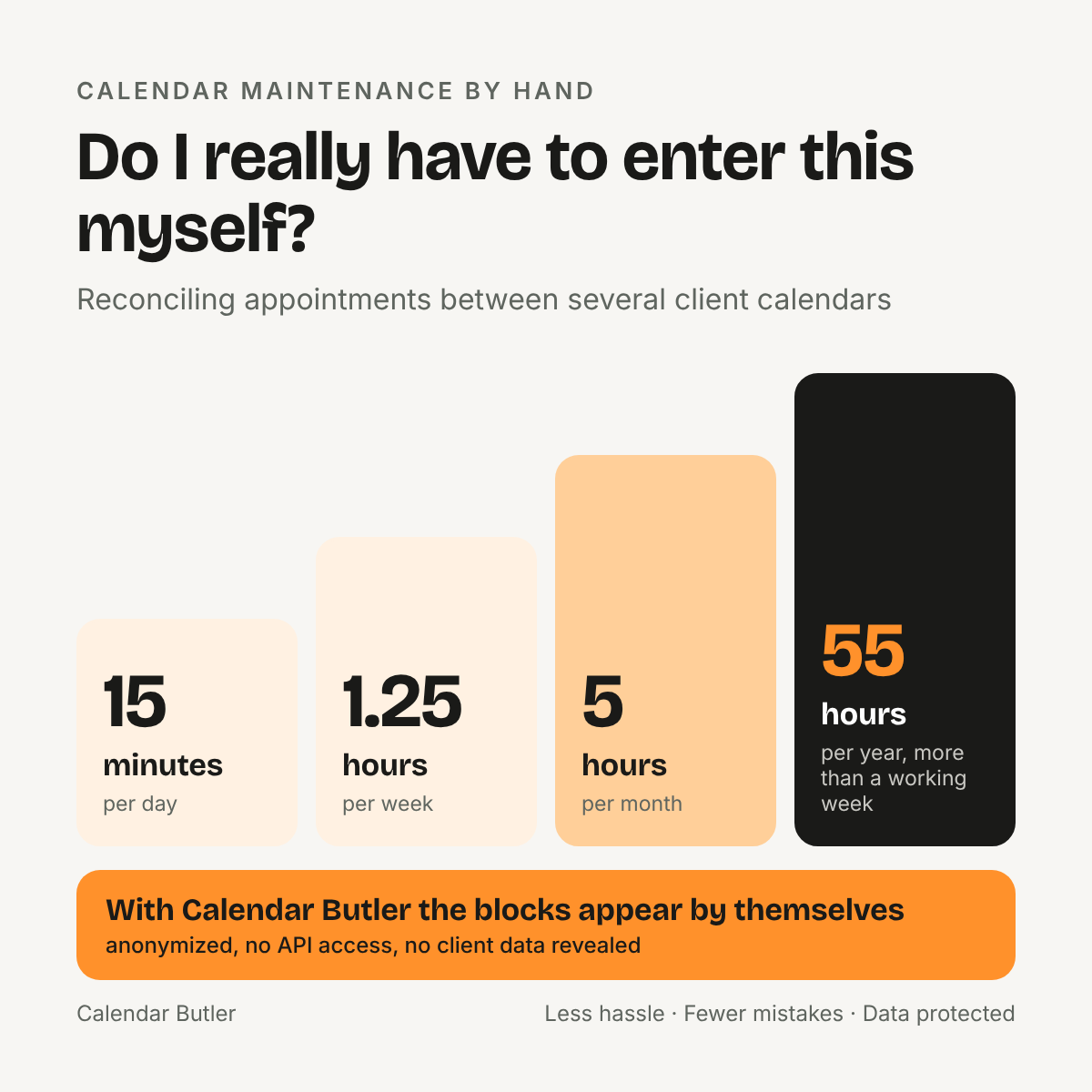
If you set aside 15 minutes a day for it, that comes to 1.25 hours a week, five hours a month and roughly 55 hours a year, more than a whole working week spent exclusively on copying entries from A to B. At an hourly rate of 100 euros that is 5,500 euros which you put not into your work but into administering your availability.
This is where the calculation of the methods tips over. A technique that in the ideal case gives you a few hours of focus time per week gains little if its precondition already swallows more time than it can ever win back.
Even the Pareto principle, according to which most results can be achieved in a small part of the working time, becomes an imposition this way: the few productive hours you want to protect are nibbled away by the administration of appointments before the actual work begins.
Maintenance does not only cost time
Maintaining by hand costs not only minutes, it also creates two risks that appear in no time management guide. The first is the mistake: anyone who copies entries into three calendars under time pressure will eventually forget a cancellation or mix up a day, and the result is a double booking that the client notices before you do. The second is data protection: anyone who types up or forwards appointments with titles and participants carries information from one client into the environment of another, possibly a competitor, and can easily breach confidentiality agreements that they signed themselves.
Breaks with a guilty conscience
One chapter of the guide is devoted to break management and recommends a screen break once an hour, a walk, deliberate boredom. That is good advice, and for many self-employed people it fails on one very concrete thing: anyone who is not sure that their calendar shows the current state looks at their phone even during the break, because an appointment may just have come in.
The unrest that arises is familiar to many from Sunday evening, when a quick check is made to see whether anything has moved since Friday. It is not a sign of a lack of discipline but the reasonable reaction to a system that is only up to date if you take care of it yourself.
The usual ways out and why they rarely hold
The obvious ways out each have a catch. Automatic synchronization through an interface would be the most elegant solution, but for reasons of IT security and data protection companies almost never hand external specialists API access to their calendars, and a request usually ends in a ticket that nobody closes. Forwarding the invitation fails because of compliance, since it makes your connection to one company visible in the other and sends participant names or attachments along. What remains is transferring by hand, which is exactly the task this is about.
On top of that, the synchronization for which online calendars are praised in the guides refers to the devices of a single account. That your phone shows the same calendar as your laptop does not help if the real gap lies between the calendars of different organizations.
A method that is meant to distribute time is only as good as the time it finds.
Calendar Butler
What a calendar nobody maintains looks like
Calendar Butler starts at exactly this point and takes over the maintenance without needing an interface. You invite it to an appointment like another participant, and it then creates anonymized blocks in your other calendars. There it says that you are not available at that time, but not with whom, for what or with whom else, so that all your clients see the same truth about your availability and none of them sees more than they are allowed to.
If the client moves the appointment or cancels, the block follows that change, without you having to check on Sunday evening whether anything has moved since Friday. The Butler is deliberately not a time management system. It replaces neither your task list nor your method, but gives both what they have so far demanded of you, namely a calendar that is correct.
What the methods can do afterwards
Only on this basis does it make sense to ask which method suits you. The Eisenhower matrix then sorts your tasks against a calendar that tells the truth, the Pomodoro technique cuts your focus phases into times that are actually free, and the frog in the morning is not displaced by an appointment you knew nothing about. The methods remain what they are, useful tools, just no longer the answer to a problem that does not lie with them.
Whether manual calendar maintenance across several client calendars is still normal answers itself almost on its own. It is normal only in the sense that almost everyone does it, because for a long time there was no alternative. It does not make sense, because it costs time, creates mistakes and endangers data, and all three problems can be solved without you having to learn a single new method.
Anyone who wants to use their time better should therefore not start with the next method but with the question of who actually maintains the calendar.
Sources
Reflections after reading the guide “Zeitmanagement für Gründer*innen” by Gründerplattform. gruenderplattform.de
Reflections after reading the article “Der Leitfaden für Freiberufler zum Zeitmanagement” by Doodle. doodle.com
Time management
Calendar maintenance
Multiple client calendars
Data protection
End the appointment ping-pong.
Calendar Butler reserves your appointments in every client calendar and keeps your data protected.
 Calendar Butler