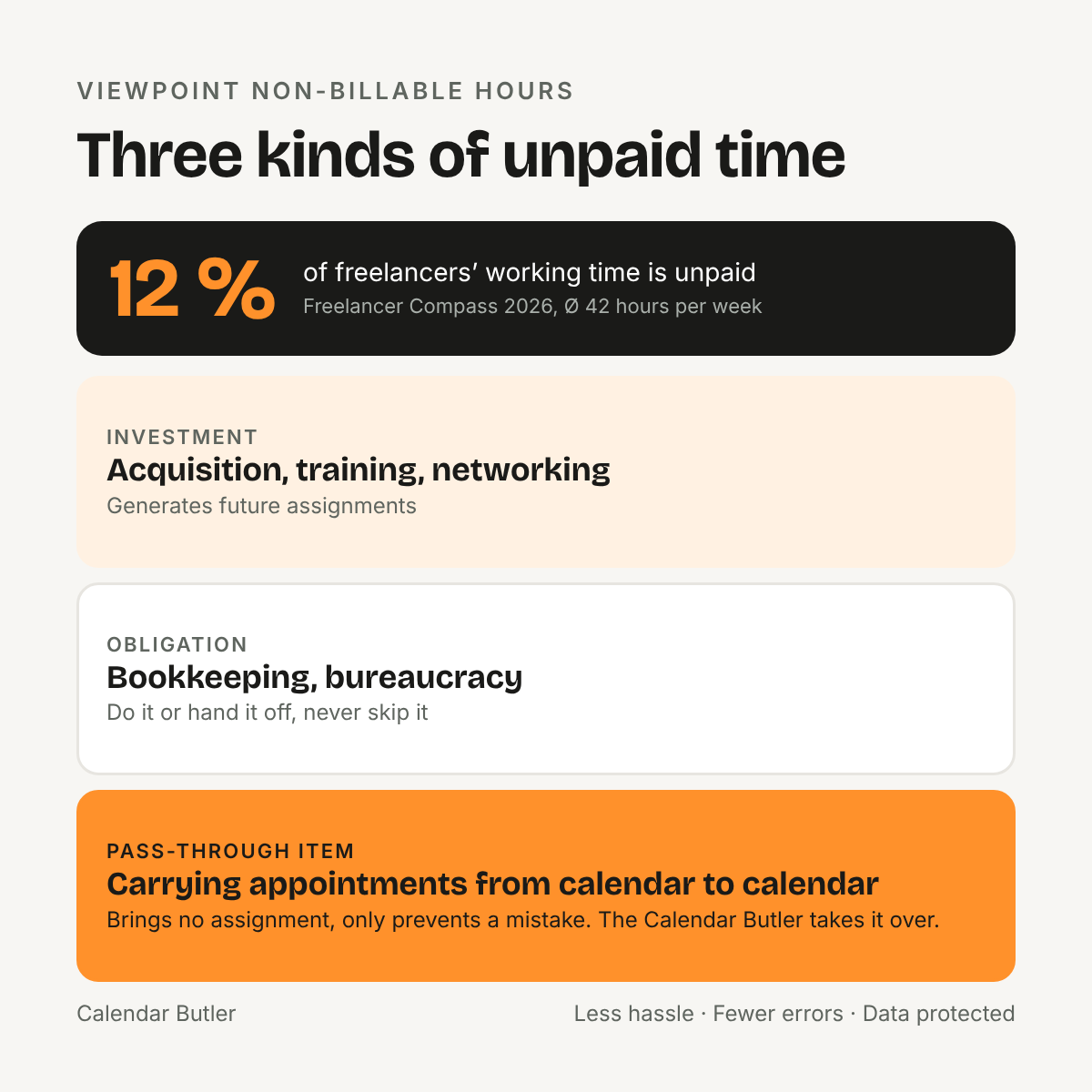
Our position on this is clear. Part of this unpaid time is an investment in future assignments, another part is a pass-through item that exists only because systems do not talk to each other, and the transfer of appointments between calendars belongs to this second part. It can be eliminated without losing anything of value.
This article puts the figures of the study into context, separates investment from pass-through items and calculates what manual reconciliation means at this scale.
The study also asks what freelancers use their non-billable hours for, and respondents could tick several answers, so the values do not add up to one hundred percent.
Calendar reconciliation does not appear in this list on its own, and that is understandable, because it is hard to name. It hides in bureaucracy, in unplanned client communication and in the feeling at the end of the day of having done a lot and achieved little.
You can sort the items on the list into three groups, and the distinction decides what you should change. Acquisition, further training, networking and self-marketing are investments, because they generate future assignments or higher rates, and whoever cuts them saves in the wrong place. Bookkeeping and part of the bureaucracy are obligations that you can do or hand off, but not leave out.
The third group consists of activities that arise only because the same information has to be in several places. An appointment with client A must also appear as taken time in client B’s calendar so that nobody books you a second time, and nobody wins an assignment or a euro more through it. The work only prevents a mistake, and it is exactly as large as the systems are unconnected.
We do not argue for cutting acquisition or further training. We argue for looking for the hours in which you only carry information from one place to another, and for giving these hours to a machine, because no value arises there that a human would have to deliver.
The Calendar Butler takes over this part. It reads an invitation once, reserves the time in your other calendars and sends an anonymous block labeled “Blocked” there, so that no client sees more than necessary and no entry is made by hand.
An honest note belongs here. The study does not record calendar reconciliation separately, and how much time you save depends on how many calendars you keep and how many appointments come up per week. A test takes one week: note every time you transfer an appointment by hand into a second calendar, and add it up on Friday.
 Calendar Butler