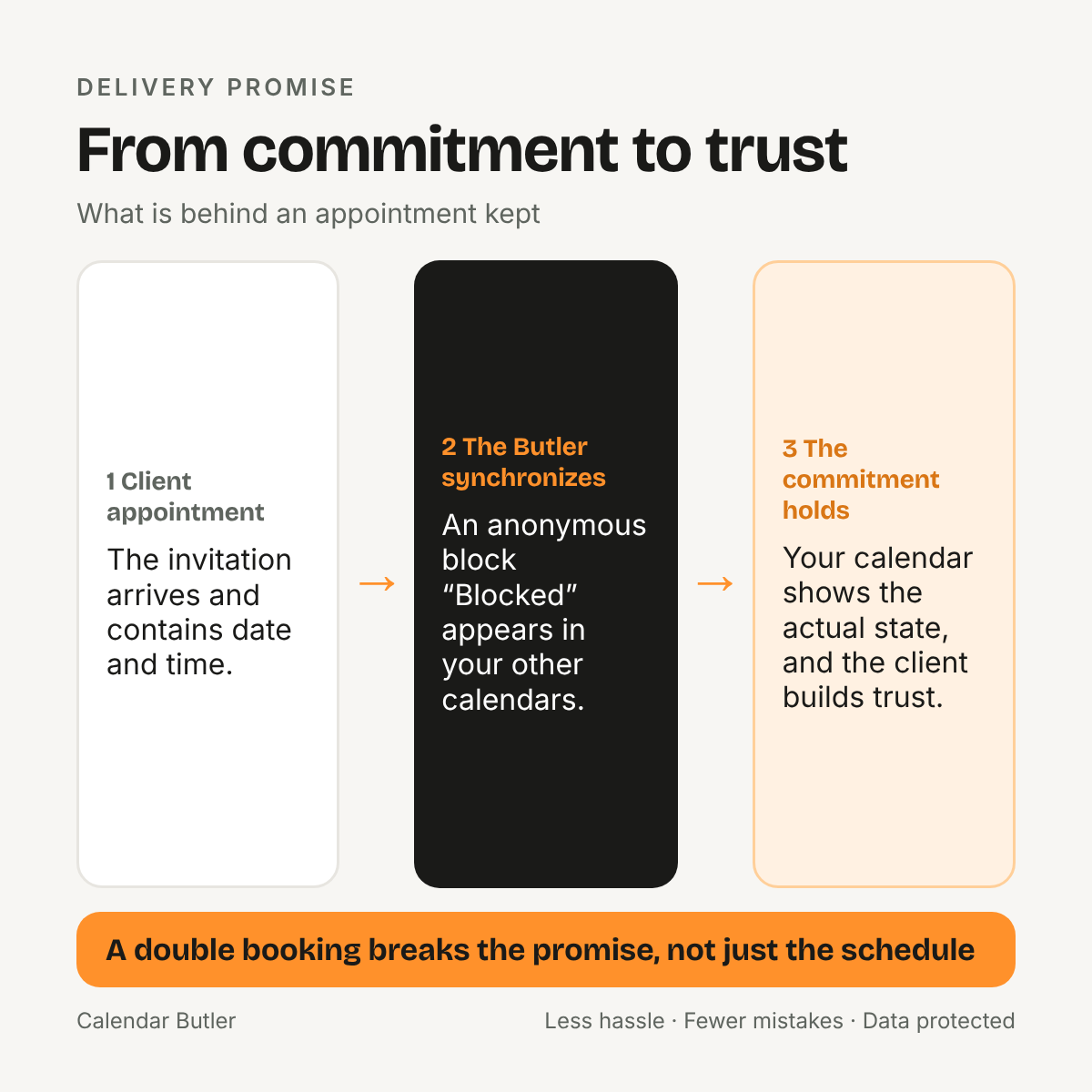
On the other side sits a client who has planned an appointment, invited colleagues and built their day around you. From their point of view a double booking is not a scheduling problem but a promise not kept, and that is exactly how you should look at your calendar.
Let us calculate with a ninety-minute workshop and eight participants. If you cancel at short notice because the same time slot was already taken by another client, twelve person-hours are lost on the client's side, and on top comes the effort of finding a new date across eight calendars, rebooking the room and explaining to the manager why the workshop is not taking place.
More expensive than this time is usually what stays behind with the client. They do not remember that you had a scheduling conflict but that your commitment did not hold, and they wonder how reliable your commitments to results and deadlines are. A second effect comes on top that is hard to avoid, because the explanation for the cancellation usually reveals that you were committed elsewhere, and for assignments with confidentiality clauses that alone is information the client should not necessarily have.
The usual answer to double bookings is to be more careful in future. Yet anyone who keeps several client calendars rarely fails for lack of care but because of a way of working that practically plans for mistakes, since every commitment depends on something having been transferred by hand beforehand.
None of these examples is a character flaw, but the foreseeable result of manual work that has to succeed again with every appointment. A promise that depends on this succeeding a hundred times a year without a single error is not a reliable promise but a bet.
A commitment becomes reliable when the synchronization does not depend on your attention but happens automatically as soon as an appointment is created, moved or cancelled. The Calendar Butler takes over exactly this task, because it reads an invitation, takes the date and time from it and sends an anonymous block to your other calendars. If the client moves the appointment or cancels it, the Butler updates the block, so that no ghost appointment stays behind.
The result is unspectacular and for that very reason valuable, because your calendar shows the actual state at the moment of the commitment, and you can say “Wednesday at two works” without first looking into three calendars. One condition remains, namely that the invitation reaches the Butler, because it can only take care of what it learns about. Anyone who invites it to appointments or forwards invitations to it has met this condition.
In the end your client never sees how much effort lies behind a commitment kept, they only see that it was kept, and that is the part that builds trust with them.
 Calendar Butler